Control which environment variables reach Harbor, sandboxes, agents, and verifiers.
Harbor separates variables by where they are needed: the Harbor process, the
sandbox, the agent phase, or the verifier phase.
Keep sandbox-provider credentials such as DAYTONA_API_KEY in the Harbor
process. Passing them through environment.env, --agent-env, or
--verifier-env unnecessarily exposes them inside the sandbox and is not
recommended.
export and --env-file do not copy every variable into the sandbox. To pass
a host variable such as DATABASE_URL, set environment.env.DATABASE_URL to
${DATABASE_URL} explicitly.
Shared verifier (default)
Separate verifier
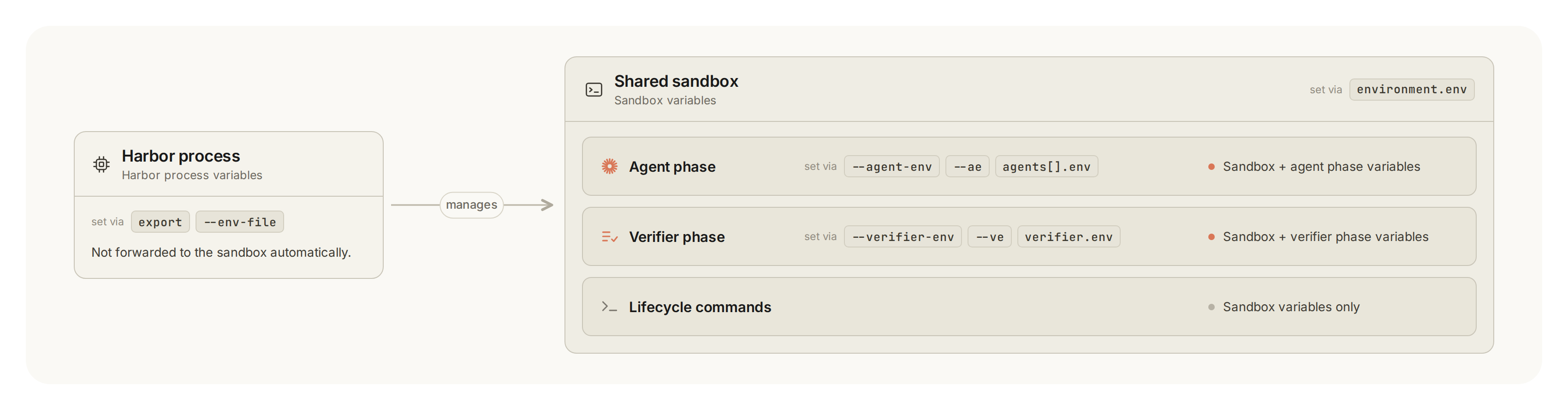
The agent and verifier run in the same sandbox.
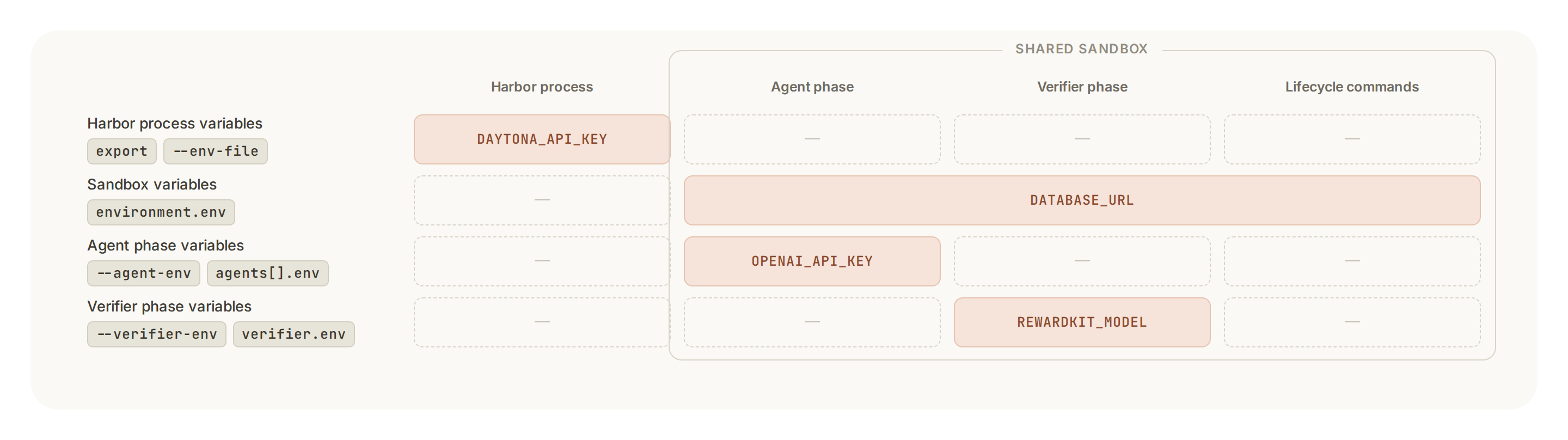
Environment variable scope for shared verifier
Lifecycle commands include health checks, step setup, and collection hooks.
They run around the agent and verifier phases and receive sandbox variables only.
Scope and availability
Shell or CLI
config.json
task.toml
Example
Harbor process and environment provider
export, --env-file
—
—
DAYTONA_API_KEY
Shared sandbox: agent, verifier, and lifecycle commands
—
environment.env
[environment.env]
DATABASE_URL
Agent phase only
--agent-env (--ae)
agents[].env
—
OPENAI_API_KEY
Verifier phase only
--verifier-env (--ve)
verifier.env
[verifier.env]
REWARDKIT_MODEL
Environment variable architecture for shared verifier
The agent, verifier, and lifecycle commands share one sandbox. Phase
variables are added only while their phase runs and override sandbox
variables with the same name.
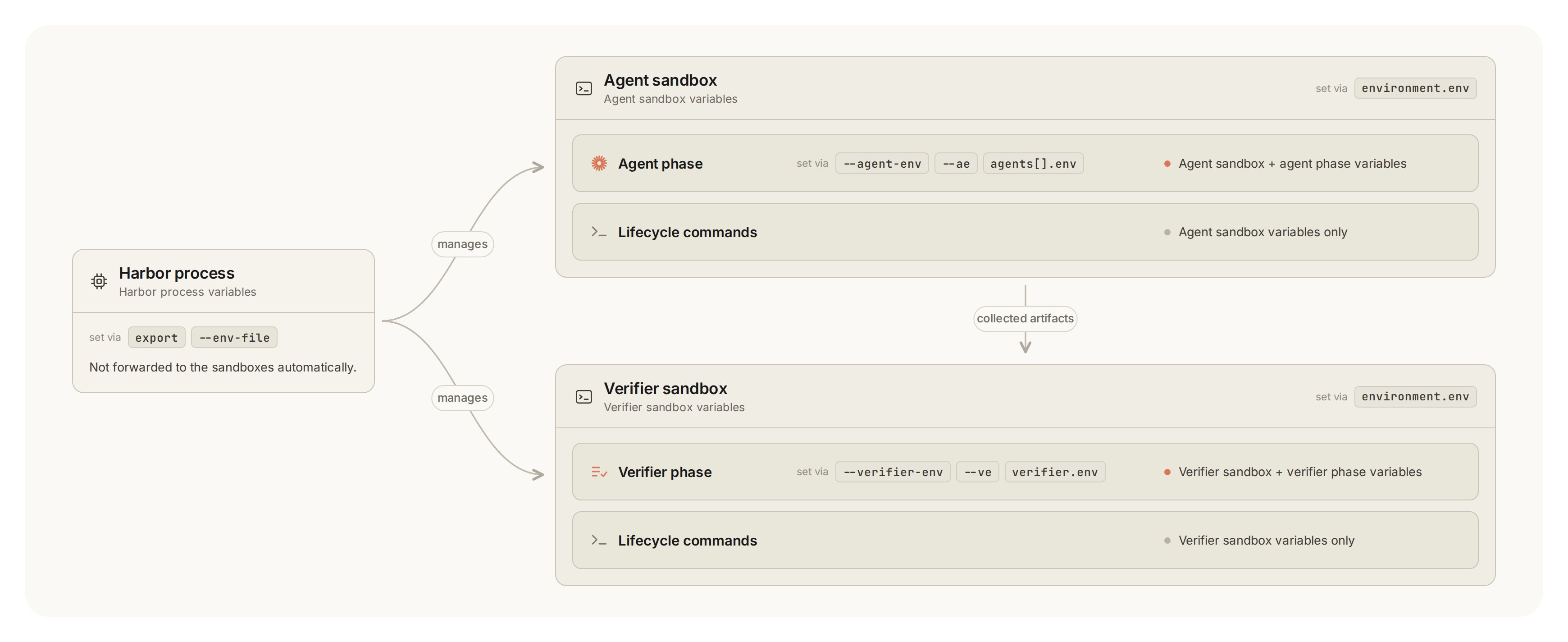
verifier.environment.env sets baseline variables for the verifier sandbox,
including its lifecycle commands. verifier.env adds variables only during
the verifier phase.
Scope and availability
Shell or CLI
config.json
task.toml
Example
Harbor process and environment provider
export, --env-file
—
—
DAYTONA_API_KEY
Sandbox baseline
—
environment.env (both sandboxes)
[environment.env] (agent sandbox)
DATABASE_URL
Agent phase only
--agent-env (--ae)
agents[].env
—
OPENAI_API_KEY
Verifier phase only
--verifier-env (--ve)
verifier.env
[verifier.env]
REWARDKIT_MODEL
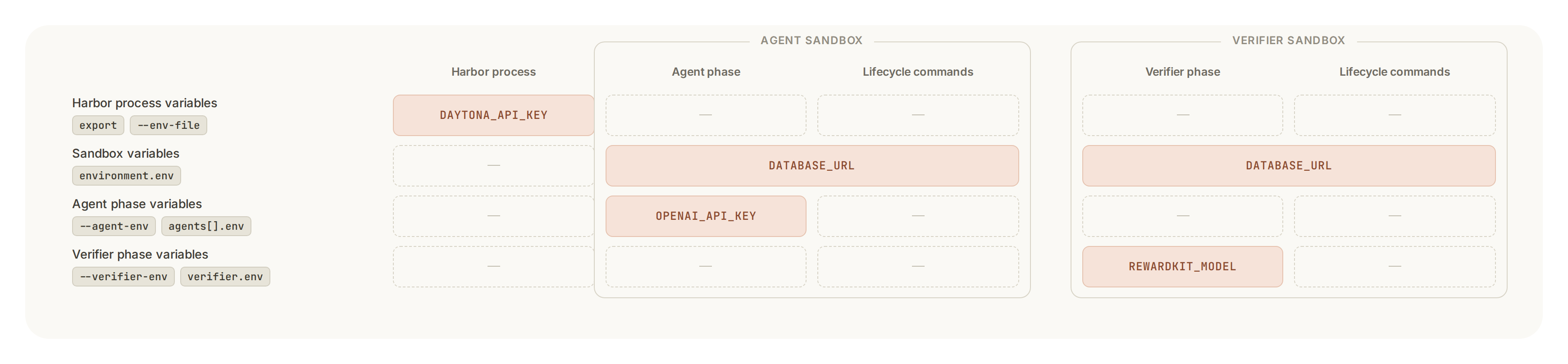
Environment variable architecture for separate verifier
If separate mode is enabled without [verifier.environment], Harbor
copies the top-level [environment]. Its [environment.env] variables
therefore become the verifier sandbox baseline as well.
Verifier-phase variables override verifier-sandbox variables with the same
name. Agent-phase variables follow the same rule in the agent sandbox.
Some built-in agents recognize
selected host variables automatically. For example, Codex reads
OPENAI_API_KEY from the Harbor process and makes it available during the Codex
agent phase. This behavior is agent-specific; unrelated host variables are not
forwarded.
Common automatic agent credential forwarding
These host credentials are available only during the named agent’s phase.
Values passed with --agent-env take precedence.
Agent
Recognized host credentials
Forwarded as
codex
OPENAI_API_KEY
OPENAI_API_KEY
claude-code
ANTHROPIC_API_KEY, ANTHROPIC_AUTH_TOKEN, or CLAUDE_CODE_OAUTH_TOKEN; for Bedrock, AWS_BEARER_TOKEN_BEDROCK or the standard AWS credential chain
ANTHROPIC_API_KEY, CLAUDE_CODE_OAUTH_TOKEN, or the original AWS variables
gemini-cli
GEMINI_API_KEY, GOOGLE_API_KEY, GOOGLE_GENERATIVE_AI_API_KEY, or GOOGLE_APPLICATION_CREDENTIALS
Google authentication variables
antigravity-cli, antigravity-sdk
GEMINI_API_KEY; antigravity-cli also recognizes GOOGLE_API_KEY
GEMINI_API_KEY
copilot-cli
COPILOT_GITHUB_TOKEN, GH_TOKEN, or GITHUB_TOKEN
COPILOT_GITHUB_TOKEN
cursor-cli
CURSOR_API_KEY
CURSOR_API_KEY
fx
AI_GATEWAY_API_KEY, VERCEL_AI_GATEWAY_API_KEY, or VERCEL_OIDC_TOKEN
Vercel AI Gateway authentication variables
openhands, openhands-sdk
LLM_API_KEY; openhands also recognizes the provider credential selected by -m
Provider-dependent agents use Harbor’s provider credential
registry.
ACP registry agents do not use this automatic forwarding; pass their credentials
with --agent-env. Other integrations may recognize additional variables; check
the agent implementation.